Meaning

Eaten out of house and home

Categorised in: A list of phrases about buildings ·135 Phrases coined by William Shakespeare

What's the meaning of the phrase 'Eaten out of house and home'?

This is one of the phrases that, while having been long attributed to Shakespeare, was in fact used earlier by others and has now been demoted to 'popularised by' rather than 'coined by' the bard. There is a definition of the expression in Thomas Cooper's glossary Thesaurus Linguae Romanae Britannicae, 1578: To eate out of house and home: to waste and consume his substance, money etc. Shakespeare picked this up in Henry IV Part II, 1597: MISTRESS QUICKLY: It is more than for some, my lord; it is for all, all I have. He hath eaten me out of house and home; he hath put all my substance into that fat belly of his: but I will have some of it out again, or I will ride thee o' nights like the mare. The expression 'house and home' denoting a person's (that is, a man's) dwelling place dates back to the beginnings of the language and is used in many contexts. It appears in The Anglo-Saxon Chronicle, 1129. See other - phrases and sayings from Shakespeare.

Eaten out of house and home
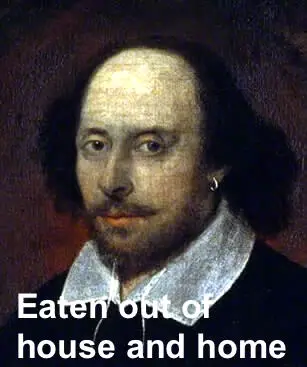
Eaten out of house and home - caption

What’s the origin of the phrase ‘Eaten out of house and home’?

This is one of the phrases that, while having been long attributed to Shakespeare, was in fact used earlier by others and has now been demoted to ‘popularised by’ rather than ‘coined by’ the bard.

There is a definition of the expression in Thomas Cooper’s glossary Thesaurus Linguae Romanae Britannicae, 1578:

To eate out of house and home: to waste and consume his substance, money etc.

Shakespeare picked this up in Henry IV Part II, 1597:

MISTRESS QUICKLY:
It is more than for some, my lord; it is for all, all I have. He hath eaten me out of house and home; he hath put all my substance into that fat belly of his: but I will have some of it out again, or I will ride thee o’ nights like the mare.

The expression ‘house and home’ denoting a person’s (that is, a man’s) dwelling place dates back to the beginnings of the language and is used in many contexts. It appears in The Anglo-Saxon Chronicle, 1129.

See other - phrases and sayings from Shakespeare.

Historical trend

“out of house and home” in printed material over time

Source: Google Books Ngrams (1800–2020).

180018201840186018801900192019401960198020002020
  • out of house and home