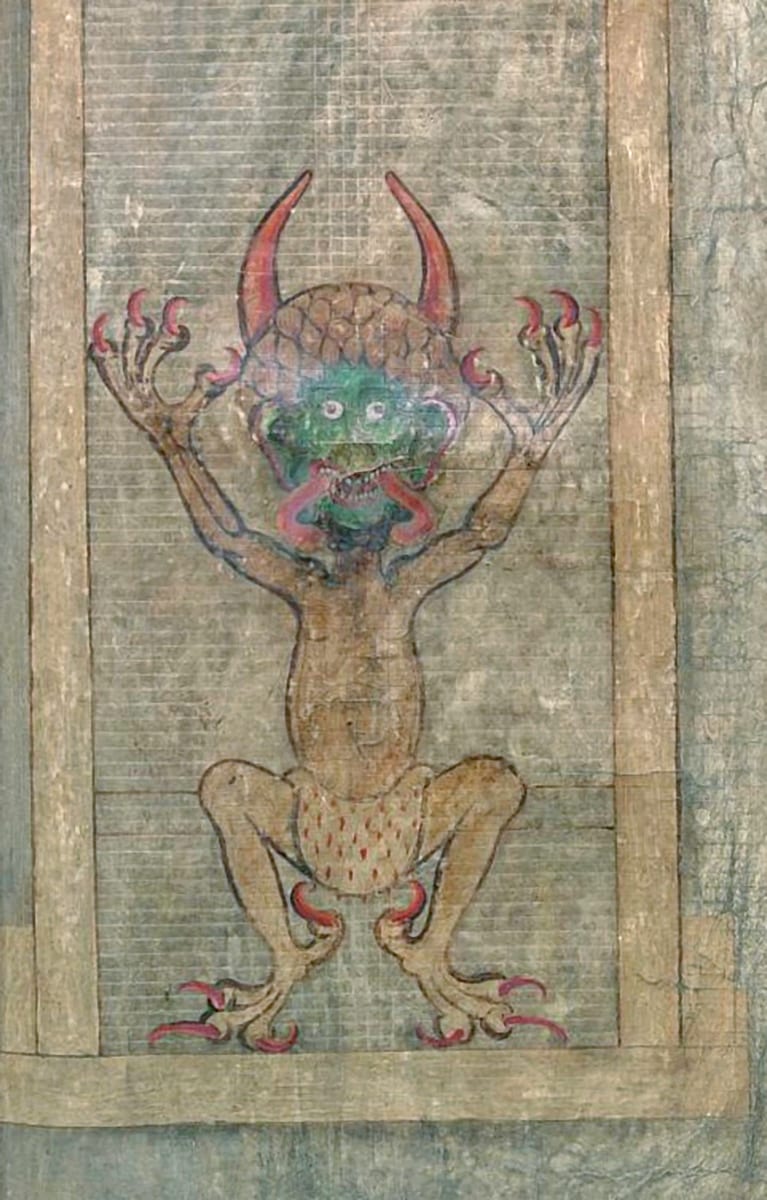
To call someone the spawn of Satan is, literally, to call them the devil’s own offspring. Hardly anyone now means it literally, or even seriously. The phrase survives as stock comic hyperbole, delivered with mock solemnity about a biting toddler, a sofa-shredding cat or a photocopier that jams on deadline. The joke is the mismatch of register: the speaker borrows the most damning label Christian theology can supply and pins it on a domestic nuisance. Said with a genuinely straight face it remains a strong insult, but that use is now the exception.
What’s the origin of the phrase ‘spawn of Satan’?
It sounds biblical, and that is no accident, but the phrase appears nowhere in the Bible. What scripture supplies is the underlying idea: that the wicked are the devil’s children. In John 8:44 (King James Version) Jesus tells his opponents “Ye are of your father the devil, and the lusts of your father ye will do”; the First Epistle of John contrasts “the children of God” with “the children of the devil”; and Revelation condemns a “synagogue of Satan”. Centuries of preachers turned that idea into a ready-made formula of abuse.
“Spawn” arrived by a separate route. In fifteenth-century English it meant fish eggs, and the etymology reference Etymonline dates its insulting figurative sense, offspring regarded with contempt, to the 1580s. The word suited the pulpit perfectly: spawn is produced cold, wet and by the thousand, so calling sinners the devil’s spawn made wickedness sound both mass-produced and sub-human. A sermon collection published in London in 1675, Richard Garbut’s One Come from the Dead, to Awaken Drunkards and Whoremongers, calls the drunkard a child of the devil “bred of his very Spawn, begot of his very Seed, bearing the very Image and Picture of the Father”.
The wording with Satan attached took longer to settle. Google Books data shows “spawn of the devil” and “spawn of hell” in steady use through the eighteenth and nineteenth centuries, while “spawn of Satan” itself stayed rare until the twentieth. One conspicuous early appearance is in Percy Bysshe Shelley’s long poem The Revolt of Islam (1818), where a fanatical priest harangues a plague-stricken crowd about the fires of hell:
those who fell By the swift shafts of pestilence ere dawn, Are in their jaws! they hunger for the spawn Of Satan, their own brethren
Victorian writers kept the “spawn of the devil” form alive as a curse for villains. In Arthur Conan Doyle’s early story My Friend the Murderer, first published in London Society in 1882, an informer snarls of two enemies: “Spawn of the devil, both of them!”
Into the twentieth century the phrase could still be used with a perfectly straight face. Montague Summers’s The History of Witchcraft and Demonology (1926) calls the twelfth-century heretic Tanchelin “this very spawn of Satan and black angel of woe”. The pulps, though, were already wearing the solemnity off it: in David A. Kyle’s story Golden Nemesis (Stirring Science Stories, February 1941) a scientist destroys his own dangerous formula crying “I’ll scatter this spawn of Satan to the winds”. The devil-child horror films of the late 1960s and 1970s, Rosemary’s Baby and The Omen among them, then made satanic offspring such a pop-culture fixture that the phrase tipped over into camp.
By the twenty-first century it was chiefly a gag. When the American columnist Ann Coulter filed a piece from the 2004 Democratic National Convention opening “Here at the Spawn of Satan convention in Boston”, USA Today declined to print it, and the deadpan-hyperbolic register of that line is the phrase’s natural habitat today. Google Books data shows its use still climbing, long after overtaking the once-commoner “spawn of the devil”, though its most frequent targets nowadays are other people’s children and badly behaved pets. Its politer cousin in the devil’s household vocabulary is speak of the devil, which likewise stopped being meant literally long ago.